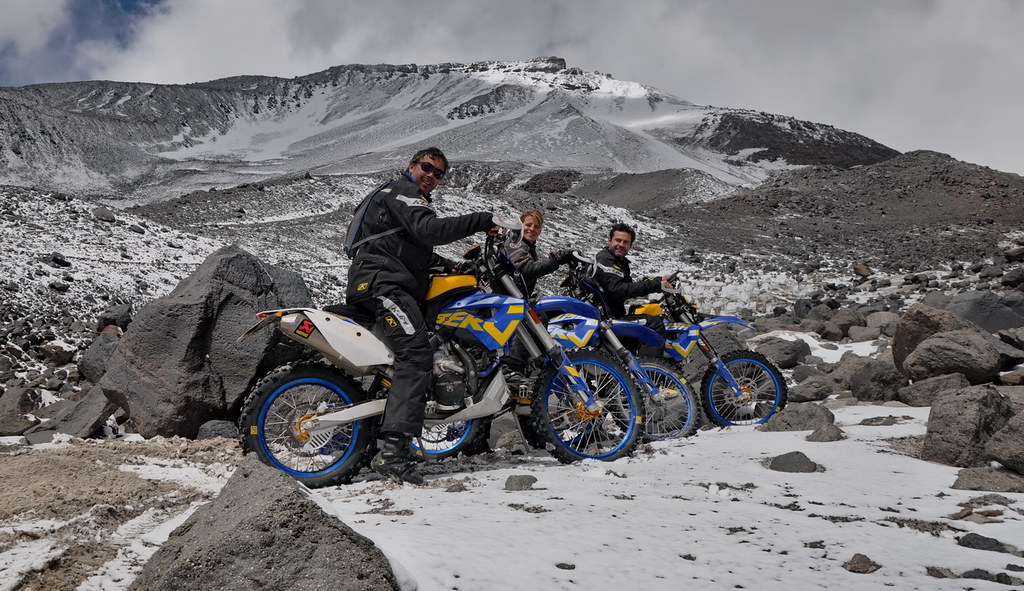
In March 2017, another Irish team headed to South America and investigated a number of peaks before settling on Ojos del Salado. Male members of the team managed to scramble above 6000m on their KTM 350 Freerides. The lady of the group, Mide Maher, also rode a KTM 350 Freeride from Rifugio Murray near the Copiapo - Fiambala highway up to a new benchmark of 5915 metres, just pipping Sherri Jo's 5903m effort with the Husaberg Adventure Team in 2012.
Focused on accurate information about the history of motorcycles at altitude. Who has done what, where and when. The risks and dangers of motorcycles at altitude. The claims and counterclaims of altitude records. Databases of the worlds highest roads, and the worlds highest and most noteworthy record rides.
Showing posts with label Women. Show all posts
Showing posts with label Women. Show all posts
Friday, 2 June 2017

Friday, 23 March 2012
World Record #1
Sherri-Jo Wilkins joined the Husaberg Adventure Team boys, thinking she was going to just be in charge of base camp. But we had other plans.

First, a dysfunctional eye meant that Walter decided to give his bike to Sherri-Jo while the team moved camp from the 4530 metre (14,862 ft) Camp Murray at the base of the mountain to the 5260m (17,257 ft) Camp Atacama, which acts as the main base camp for climbers on Ojos del Salado. Walter drove the truck. Sherri-Jo rode the bike to Camp Atacama. It was there that we told her the womens altitude record is just about 125 metres higher at 5,386m (17,671 ft). We looked Sherri-Jo in the eye and told her that she is borrowing Walter's bike again tomorrow, and we were going as high as the path would take us.
The hardest part of the ride was the first 125 vertical metres out of Camp Atacama ... the metres she needed to set the record. So the Husaberg Adventure team decided to help out, stabilising the bike where necessary, while SJ worked that 570cc Husaberg engine to the max on the steep sands above Camp Atacama. Ten minutes later and it was all over. We all grouped together at the side of the track and looked at the GPS on Walter's bike. SJ had made it to 5,409m (17,746 ft) ... a new world record.

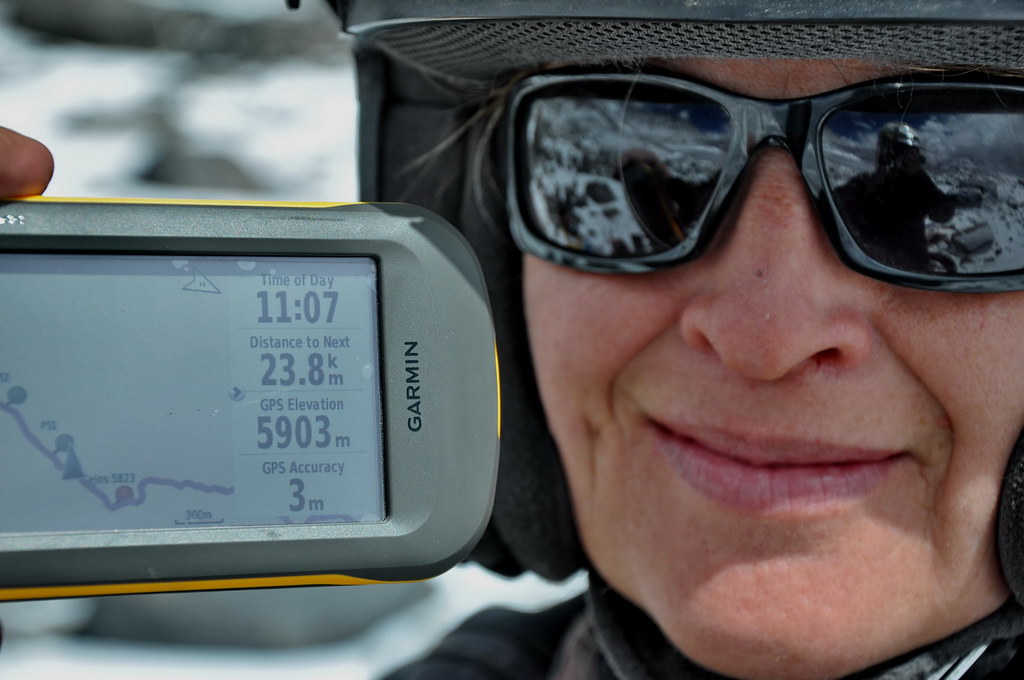
But we weren't finished with her yet - and SJ wasnt finished with the mountain. It had been a struggle to get to that point but we told SJ she must go on ... and that the path gets easier from here. She bravely steeled herself and continued the ride, led by Lukas M, with Walter operating the helmet cam unit right behind SJ ... It got colder and colder as we rose and the snow over our intended path got thicker and thicker ... but SJ continued on. By the time we all stopped, SJ had reached 5,903m (19,367 ft) ... she hadnt just beaten the world record, she had humiliated it. Crushed it. By 517 metres !


Congratulations to Sherri-Jo Wilkins for setting a new womens world record for motorcycle altitude. Now the boys were even more determined to get their own world record !

First, a dysfunctional eye meant that Walter decided to give his bike to Sherri-Jo while the team moved camp from the 4530 metre (14,862 ft) Camp Murray at the base of the mountain to the 5260m (17,257 ft) Camp Atacama, which acts as the main base camp for climbers on Ojos del Salado. Walter drove the truck. Sherri-Jo rode the bike to Camp Atacama. It was there that we told her the womens altitude record is just about 125 metres higher at 5,386m (17,671 ft). We looked Sherri-Jo in the eye and told her that she is borrowing Walter's bike again tomorrow, and we were going as high as the path would take us.
The hardest part of the ride was the first 125 vertical metres out of Camp Atacama ... the metres she needed to set the record. So the Husaberg Adventure team decided to help out, stabilising the bike where necessary, while SJ worked that 570cc Husaberg engine to the max on the steep sands above Camp Atacama. Ten minutes later and it was all over. We all grouped together at the side of the track and looked at the GPS on Walter's bike. SJ had made it to 5,409m (17,746 ft) ... a new world record.

But we weren't finished with her yet - and SJ wasnt finished with the mountain. It had been a struggle to get to that point but we told SJ she must go on ... and that the path gets easier from here. She bravely steeled herself and continued the ride, led by Lukas M, with Walter operating the helmet cam unit right behind SJ ... It got colder and colder as we rose and the snow over our intended path got thicker and thicker ... but SJ continued on. By the time we all stopped, SJ had reached 5,903m (19,367 ft) ... she hadnt just beaten the world record, she had humiliated it. Crushed it. By 517 metres !
Congratulations to Sherri-Jo Wilkins for setting a new womens world record for motorcycle altitude. Now the boys were even more determined to get their own world record !
Wednesday, 8 February 2012
Where Will We Do the Ride?
The Location - Ojos del Salado
Where is the ideal place to try and break an altitude record
for motorcycles? A read through our
articles on the history of people riding high has shown that historically most
high rides have been in the Himalaya.
Over the past 5-6 years, however, there has been an equally strong drive
to look to South America and the Andes.
We agree with the South American logic and intend to head there for our attempt, and
one mountain in particular, Ojos del Salado.
The idea of riding high has been in my head for several
years. Initially I was interested in the
Indian Himalaya. There are loads of regular
roads and passes up above 5,000 metres high.
Those passes are obviously a base to attempt to ride higher, if the
ground surrounding the pass is rideable.
The idea was developed further in the Pamir in 2009, when I rode a pass
at 4,665 metres, but noticed much of the surrounding terrain was not
particularly steep and was in fact quite gentle and rounded.
I spoke at length with Indian biker and fantastic moto
photographer Mani Babbar, who had himself ridden to Marsimik La, and looking at
his pics, the possibilities were clearly there to ride higher, provided the
bikes had more power than they typical Indian 15 hp, 150cc carb’d bikes that
rode up there. This theory was conclusively proved by the
current world record, which was a bunch of Indian guys who rode up to Marsimik
La and then made their way up the hillsides another 600 metres of vertical.
But the more we looked into it and discussed it, the more
the Andes made sense. While the Andes are
not as high as the Himalaya, that additional height is pretty much a moot
point, since no-one is riding high enough to challenge the summits of the
Andes, let alone the Himalaya. And the
Andes have one huge advantage … the slopes of the mountains are often less
steep.
The clincher for us, around June last year, was studying the assorted videos and
stories of the last two world records for cars.
Both drives were in 2007, both were over 400 metres higher than any bike
has ever gone, and one of the drives was in a near stock Jeep Wrangler. Importantly, both drives were on one
particular mountain … Ojos del Salado … Eyes of Salt.

Ojos del Salado is the second highest mountain in the Andes,
and indeed in all of South America.
Perhaps most importantly, it is the world’s highest volcano. Volcanoes tend not to be extremely steep, and
their slopes tend to be very even, compared with regular mountains. This is because volcanoes are formed by ash and molten lava flowing down from the top, rather than the earth violently heaving upwards, as is the case with regular mountains. Ojos del Salado will, however, not be a
cakewalk. Being a volcano, the slopes
feature significant amounts of sand like ash.
There are glaciers to cross on
our route; and fields of ice javelins called penitentes. The area is remote. The nearest town, including fuel and water,
is 300 km (190 miles) away. It’s one of
the windiest areas on the planet, and even in summer temperatures can drop to
-25C. The remoteness means we must be
100% self contained, and very careful.
Injury either from accident or from altitude will spell the end of the
project for at least one of us.

Despite the remoteness, it will be to Ojos del Salado that
we head in less than 4 weeks time, to begin the process of acclimatisation and
ultimately, to take on the world’s highest volcano itself.
Tuesday, 7 February 2012

Thursday, 2 February 2012
The Altitude Review - Part 3
In this third and final part of this series, we take a look
at the most recent high rides, and of course the highest rides of all. While a few of these rides have taken place in
the usual suspect range, the Himalaya, you will note quite a bit of recent attention
moving towards the Andes mountains in South America. We see the logic of this, which is why we too
will be heading to the Andes mountains in South America for our little altitude
ride. And on that note, let’s start off
in the Andes:
Miles McEwing, a Canadian race car driver and his wife Tracey
took on a different speed when they headed to South America with a 2WD Ural
sidecar rig in 2011. Always up for a
challenge, the mercurial McEwing took his Ural sidecar rig up to an impressive 5,300
metres (17,388 ft) in Peru / Chile. We reckon that’s possibly a sidecar altitude record ... unless someone has gone over Khardung La in a sidecar.

Joe Pichler: KTM’s
legendary “Ambassador of Adventure” rode a regular garden variety, touring
equipped, hard metal boxed 990 Adventure up to 5,796 metres (19,016 feet) in
2007 on the sides of a volcano in the Bolivian Andes, while on a 2-up tour of
the continent with his wife Renate. Renate only jumped off at 5,600 m, which in itself has to be a record for 2-up riding at altitude. Overall we reckon Joe's 990 is the biggest bike to ever
make it up to the rarefied air of 19,000 feet. (


Globebusters: The BMW
affiliated UK based motorcycle tour company regularly guides its clients
through Tibet on a route that takes the clients, including their female Expediton
Guide Tiffany Coates, as well as several female clients, up to a pass along normal roads at 5,386 metres (17,670 feet ). We reckon this is quite possibly a women’s
motorcycle altitude record.

Craig Bounds / Tamsin Jones: British Dakar rider Craig Bounds and his

There is an incredible story out there about some Catalan riders who flew to South America in 1977 to try to ride their Bultaco bikes up Aconcagua, the highest mountain in South America, and indeed the highest mountain outside of Asia. Their story is a great read but it is peppered with factual inconsistencies and inaccuracies that ultimately make their claim to have reached somewhere around 6,820 metres (22,375 ft) very difficult to believe. The jist of their story is that they got to the Berlin Refugio which they claimed to be at 6,800 metres. then scrambled another 20 metres or so higher before weather beat them back. The biggest problem with the story is that the Berlin Refugio is at 5,850 m (19,194 ft), approximately 1,000 metres (over 3,000 ft) lower than their claim. We reckon they made it to somewhere about 5,875m (19,275 ft) which would still have been a record ride for that time, if they had got some even vaguely accurate altitude measurements. Stories like this do justify Guinness having quite strict verification standards.

Chilean / Swiss / Austrian Motorecord project: In early 2008, a well
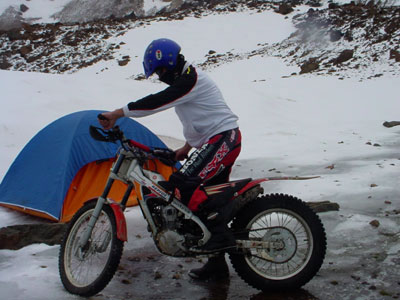
organised multinational team took trials bikes with sand tyres to Ojos del Salado in Chile, managed to get up to 6,220 metres, (20,406 feet) and in doing so scored a
new Guinness World Record and overtook the unofficial record of Juhasz (by about 40 metres) which had stood for over a decade. The fuelling was an issue on the trials bikes, and there was talk the project would one day return to Ojos del Salado for a second project, this time with fuel injection. We have a few reservations about using unregistered bikes for a project like this. Every other ride we have detailed in this series, including the world record Indian ride below, has used registered, number plated, regular street legal motorcycles. We feel the spirit of adventure motorcycling implies that the bikes should be registered and plated, even if it isn't a requirement of the Guinness verification process.
North Kolkata Disha: A
motorcycle club from Calcutta, India; we take our hats off to these guys. Six guys set off from steamy Calcutta in late 2008
to take the Guinness World altitude Record for bikes away from the Motorecord
project and bring it back to the Indian Himalaya: and indeed they did it, topping them by just 25 metres, and it is the record that stands to this
day. These guys got to 20,488 feet (6,245 metres ) on 29th
August 2008, by first heading to Marsimik La and then making their own trail
over 600 metres
higher, above the pass. Sadly I am unaware of any write up of this ride, nor of any photos.
Nationalism: It's worth mentioning how much nationalism is involved in some of the rides. In earlier reports we mentioned how altitudes on signs have been inflated so that India can claim (incorrectly) the highest this and the highest that. And some of the nationalism visible in some of the rides is quite overtly apparent (see pic below - with a sign inflated by a ridiculous 1300 feet!). The Chinese Guinness World Record was similarly obviously a nationalistic project - an attempt to somehow illustrate the superiority of the Chinese over all others. We are very pleased to say that as a multinational team, we are clearly NOT involved in a futile attempt to prove the superiority of one group of people over others based on the type of passport we happen to hold. We are just a group of friends who just want to have fun and try to ride higher than anyone else has before.
Nationalism: It's worth mentioning how much nationalism is involved in some of the rides. In earlier reports we mentioned how altitudes on signs have been inflated so that India can claim (incorrectly) the highest this and the highest that. And some of the nationalism visible in some of the rides is quite overtly apparent (see pic below - with a sign inflated by a ridiculous 1300 feet!). The Chinese Guinness World Record was similarly obviously a nationalistic project - an attempt to somehow illustrate the superiority of the Chinese over all others. We are very pleased to say that as a multinational team, we are clearly NOT involved in a futile attempt to prove the superiority of one group of people over others based on the type of passport we happen to hold. We are just a group of friends who just want to have fun and try to ride higher than anyone else has before.

And that basically takes us to where we are today ... with a multinational trio from the US, Austria and the UK, about to ship 3 Husaberg motorcycles to South America ... to take on this mountain ... and the existing motorcycle record of 6,245 metres (20,488 ft).

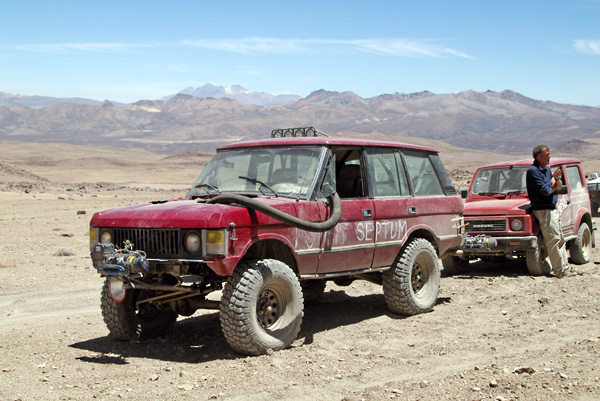
A final note ... by way of comparison, the car record is a lot higher than the motorcycle record (by about 450m / 1500 feet). That record is 6,688 metres (21,942 ft) set on the slopes of Ojos del Salado, in Chile
Monday, 30 January 2012
The Altitude Review - Part 2
In this second part of the series, we begin to take a look at some of the great rides of the past; the rides of previous record holders Shinji Kazama and Istvan Juhasz. We also take a look at the more recent (and well documented) ride of Damon I'Anson on one of the heavier bikes to see the upper side of 5,700m. All of these rides took place in the highest mountain range on earth, the Himalaya - from China, from India and from Nepal. Lets start with perhaps the greatest extreme adventure record holder of them all - Shinji Kazama.

Before Kazama, a number of Bultaco backed rides had proved the benchmark. In 1973 five Bultaco Sherpa-T 350 bikes set a new world record when they reached 5,156 m (16,916 ft) in the nepalese Imja Khola glacier in the Cukung Valley. The expedition also hired 55 sherpas (35kgs each) to take all the material needed (aeronautical gas was needed due to the poor quality of the nepalese gas combined with the high compression engines). The story is in a book called "Himalaya Namasté" from Dimas Vega, one of the expedition members.

The 1974 Igualada-Kilimanjaro expedition: Jaume Travesset and Santi Godó rode two Bultaco Sherpa-t 250 bikes from Barcelona across Africa and to the top of Kilimanjaro's Uhuru Peak - 5,891 m (19,327 ft). They reached the summit at 5pm on October 26, 1974. The expedition took 4 months and 20.000kms through Spain, Morocco, Spanish Sahara, Mauritania, Senegal, Malí, Ivory Coast, Ghana, Togo, Dahomey, Nigeria, Cameroon, CAR, Zaire, Rwanda and Tanzania.
It wasn't until the mid 1990s that Kazama's feats would be challenged. In 1995 a solo Hungarian in an all red outfit, Istvan Juhasz, rode an XL250R up the side of Gauri Shankar, a Nepalese mountain in the Himalaya, with the assistance of a trekking company and reached an impressive 6,183m (20,285 feet) where cold and fuelling limited progress. Istvan Juhasz has a pretty strong claim to have been the first person to cross the 20,000 foot mark on 2 wheels.


Shinji Kazama: The
legendary Kazama-san was seen in Michael Palin’s Pole to Pole documentary series
flying a motorcycle to Antarctica so that he could ride a bike to the South
Pole … and indeed he did. On top of that the Japanese adventurer has ridden a bike across the North Pole’s pack ice, the same pack ice that
saw Jeremy Clarkson struggle in his 4WDs.
Where Clarkson struggled, Kazama powered on and reached the North Pole. Kazama was an amazing rider. He competed in 4 Dakars. He even won the 500 cc class one year in the
days when 500cc was small by Dakar 5,880
metres (19,291 feet ) in 1984. He returned to Everest, this time on the
North (Chinese) side with a team of helpers in 1985 and made it to 6,005 metres (19,701 feet ). This stood as an unofficial record for many
years. In fact for a decade Kazama was not only the highest rider on the planet, he was the only person to have ridden to both poles (and still is). Walter has nicknamed his Husaberg "Kazama-san" in honour of this "emperor" of extreme adventure motorcycling.

Before Kazama, a number of Bultaco backed rides had proved the benchmark. In 1973 five Bultaco Sherpa-T 350 bikes set a new world record when they reached 5,156 m (16,916 ft) in the nepalese Imja Khola glacier in the Cukung Valley. The expedition also hired 55 sherpas (35kgs each) to take all the material needed (aeronautical gas was needed due to the poor quality of the nepalese gas combined with the high compression engines). The story is in a book called "Himalaya Namasté" from Dimas Vega, one of the expedition members.

The 1974 Igualada-Kilimanjaro expedition: Jaume Travesset and Santi Godó rode two Bultaco Sherpa-t 250 bikes from Barcelona across Africa and to the top of Kilimanjaro's Uhuru Peak - 5,891 m (19,327 ft). They reached the summit at 5pm on October 26, 1974. The expedition took 4 months and 20.000kms through Spain, Morocco, Spanish Sahara, Mauritania, Senegal, Malí, Ivory Coast, Ghana, Togo, Dahomey, Nigeria, Cameroon, CAR, Zaire, Rwanda and Tanzania.
It wasn't until the mid 1990s that Kazama's feats would be challenged. In 1995 a solo Hungarian in an all red outfit, Istvan Juhasz, rode an XL250R up the side of Gauri Shankar, a Nepalese mountain in the Himalaya, with the assistance of a trekking company and reached an impressive 6,183m (20,285 feet) where cold and fuelling limited progress. Istvan Juhasz has a pretty strong claim to have been the first person to cross the 20,000 foot mark on 2 wheels.

The Chinese: Kicked
of the current Guinness recognition of the motorcycle altitude game by getting a 2002 ride with considerable support and backing, up the North side of Everest suitably certified and verified. (there is a lot of verification involved with Guinness). They too crossed the 20,000 foot barrier
before topping out at 6,113 metres (20,060 feet).
Damon I’Anson: Unaware of the other significant rides, British moto journalist I’Anson went to Ladakh to set a world altitude record for bikes and document it for the UK’s Bike magazine in 2007. He creditably rode his XT660R from the UK all the way to the 5,582 metre pass, Marsimik La, then with his Indian co-rider Pankaj, found a way up the scree covered hillsides until exhaustion and lack of traction took their toll and they could go no higher. They reached 5,713 metres (18,743 feet) and reckoned it was probably about as high as anyone had ever been on a bike. “I was able to ride a Yamaha XT660-R to 18,743ft, which I believe is the highest anyone has ever ridden”. It was, however, still a long way below the efforts of Shinji Kazama, not to mention the 2002 Chinese Guinness World Record that was standing at the time 400 metres higher, and Istvan Juhasz’s ride another 70 metres higher again. I'Anson's documentary article also noted the absurd discrepancies between altitudes claimed on Indian signs and reality as seen by his GPS. He now runs tours in the Indian Himalaya.
Damon I’Anson: Unaware of the other significant rides, British moto journalist I’Anson went to Ladakh to set a world altitude record for bikes and document it for the UK’s Bike magazine in 2007. He creditably rode his XT660R from the UK all the way to the 5,582 metre pass, Marsimik La, then with his Indian co-rider Pankaj, found a way up the scree covered hillsides until exhaustion and lack of traction took their toll and they could go no higher. They reached 5,713 metres (18,743 feet) and reckoned it was probably about as high as anyone had ever been on a bike. “I was able to ride a Yamaha XT660-R to 18,743ft, which I believe is the highest anyone has ever ridden”. It was, however, still a long way below the efforts of Shinji Kazama, not to mention the 2002 Chinese Guinness World Record that was standing at the time 400 metres higher, and Istvan Juhasz’s ride another 70 metres higher again. I'Anson's documentary article also noted the absurd discrepancies between altitudes claimed on Indian signs and reality as seen by his GPS. He now runs tours in the Indian Himalaya.

Saturday, 28 January 2012
The Altitude Review - Part 1
How high can motorcycles go? Who has been where, how high and when? Over the coming week we will provide a little background to motorcycles at altitude, and the altitude record in a 3 part blog post. Let's kick off part one with some of the more well known locations for riding high!
The highest motorable road in the world … at least that’s what it claims of itself, is Khardung La, a pass on the Manali – Leh road in the Northern Indian region of Ladakh. The road has been ridden by thousands of motorcyclists over the years. The sign at the pass (see below) says 18,380 feet (5,602 metres). Now we don’t know how you precisely define “motorable”, but defining feet and metres is a much simpler game. The reality is Khardung La is actually 5,359 metres (17,582 feet) as defined by GPS surveys, satellite mapping, etc. That's 800 feet below what is claimed on the sign. So if Khardung La is only 5,359 metres, then the first thing that is apparent is that altitude claims on signs are of particularly limited value (apart from for the sake of glory photos), especially when anecdotal evidence from locals tells of how the altitudes were deliberately falsified on the signs for the sake of providing superlatives … such as the “highest motorable road” on the planet. Certainly there are other higher, just as motorable roads across the border in Tibet, such as Semo La, which is verified at 5,565m (18,258 feet). So in reality, Khardung La is neither the highest motorable road in the world, nor is it 18,380 feet above sea level. The sign at the pass is false in every sense, and deliberately so.

Also in the Indian Himalaya, Marsimik La is claimed by others (Indian local authorities) to be the location of the highest road / track in the world though it’s certainly less “motorable” than Khardung La. It’s a military road that is closed to the general public, unless you have special permission to be there. Never-the-less, Marsimik La has seen frequent 2 wheeled expeditions from numerous Indian motorcycle clubs – often on 150cc bikes! Respect !! Legendary Swedish explorer Sven Hedin crossed the pass in the early 20th century, but alas he was not on a Husaberg nor indeed on any motorcycle.
The sign atop Marsimik La (see below) claims its altitude is 18,634 feet – 5,590 metres. But if we have learned anything about Indian pass signs, it’s that they need to be treated with a very large dose of scepticism. For starters, basic conversion maths should show something incorrect with this sign. They have conjured 300 extra feet out of dodgy mathematics. 5,590 metres (if it were accurate) would translate as 18,339 feet, and not 18,634 feet. However, the 5,590 metres stated on the sign is also not accurate, and of course it’s overstated - but in this case only by a small amount. Satellite mapping and GPS data puts Marsimik La at 18,314 feet (5,582 metres), 320 feet below what is claimed on the sign.
[The sign at Marsimik La states (claims) "Marsimik La. World's highest motorable pass. Alt 5590 mts, 18634 ft"]

Top Gear: While its definitely not motorcycling, it was watched by a large audience and is therefore a quite well known piece on vehicles at altitude. In the Bolivian special, the top gear chaps went higher and higher up the mountains on the Chilean edge of the Bolivian Altiplano in their 4WDs; eventually reaching 17,200 feet (5,243 metres). They began suffering from headaches and potentially fatal hypoxia (not enough oxygen in the blood) and had to turn back. As extreme as they made it sound, it is worth bearing in mind that they were still on pretty well worn gravel roads that kept going higher, and their effort is a still below the hundreds of people who cross Khardung La (5,359 m) every day. Still, it made for dramatic TV.

The highest motorable road in the world … at least that’s what it claims of itself, is Khardung La, a pass on the Manali – Leh road in the Northern Indian region of Ladakh. The road has been ridden by thousands of motorcyclists over the years. The sign at the pass (see below) says 18,380 feet (5,602 metres). Now we don’t know how you precisely define “motorable”, but defining feet and metres is a much simpler game. The reality is Khardung La is actually 5,359 metres (17,582 feet) as defined by GPS surveys, satellite mapping, etc. That's 800 feet below what is claimed on the sign. So if Khardung La is only 5,359 metres, then the first thing that is apparent is that altitude claims on signs are of particularly limited value (apart from for the sake of glory photos), especially when anecdotal evidence from locals tells of how the altitudes were deliberately falsified on the signs for the sake of providing superlatives … such as the “highest motorable road” on the planet. Certainly there are other higher, just as motorable roads across the border in Tibet, such as Semo La, which is verified at 5,565m (18,258 feet). So in reality, Khardung La is neither the highest motorable road in the world, nor is it 18,380 feet above sea level. The sign at the pass is false in every sense, and deliberately so.

Also in the Indian Himalaya, Marsimik La is claimed by others (Indian local authorities) to be the location of the highest road / track in the world though it’s certainly less “motorable” than Khardung La. It’s a military road that is closed to the general public, unless you have special permission to be there. Never-the-less, Marsimik La has seen frequent 2 wheeled expeditions from numerous Indian motorcycle clubs – often on 150cc bikes! Respect !! Legendary Swedish explorer Sven Hedin crossed the pass in the early 20th century, but alas he was not on a Husaberg nor indeed on any motorcycle.
The sign atop Marsimik La (see below) claims its altitude is 18,634 feet – 5,590 metres. But if we have learned anything about Indian pass signs, it’s that they need to be treated with a very large dose of scepticism. For starters, basic conversion maths should show something incorrect with this sign. They have conjured 300 extra feet out of dodgy mathematics. 5,590 metres (if it were accurate) would translate as 18,339 feet, and not 18,634 feet. However, the 5,590 metres stated on the sign is also not accurate, and of course it’s overstated - but in this case only by a small amount. Satellite mapping and GPS data puts Marsimik La at 18,314 feet (5,582 metres), 320 feet below what is claimed on the sign.
[The sign at Marsimik La states (claims) "Marsimik La. World's highest motorable pass. Alt 5590 mts, 18634 ft"]

Top Gear: While its definitely not motorcycling, it was watched by a large audience and is therefore a quite well known piece on vehicles at altitude. In the Bolivian special, the top gear chaps went higher and higher up the mountains on the Chilean edge of the Bolivian Altiplano in their 4WDs; eventually reaching 17,200 feet (5,243 metres). They began suffering from headaches and potentially fatal hypoxia (not enough oxygen in the blood) and had to turn back. As extreme as they made it sound, it is worth bearing in mind that they were still on pretty well worn gravel roads that kept going higher, and their effort is a still below the hundreds of people who cross Khardung La (5,359 m) every day. Still, it made for dramatic TV.
Subscribe to:
Posts (Atom)